Stop Guessing, Start Planning: How to Turn Your Weight Loss Goal into a Sustainable Daily Diet
Most weight-loss attempts fail on the same day they begin — not for lack of willpower, but because the goal is announced without a bridge to the plate. “Lose 20 pounds in three months” is a wish. A daily calorie number, a phased timeline, and a list of meals you actually enjoy is a plan. Here is the exact three-step path between the two.
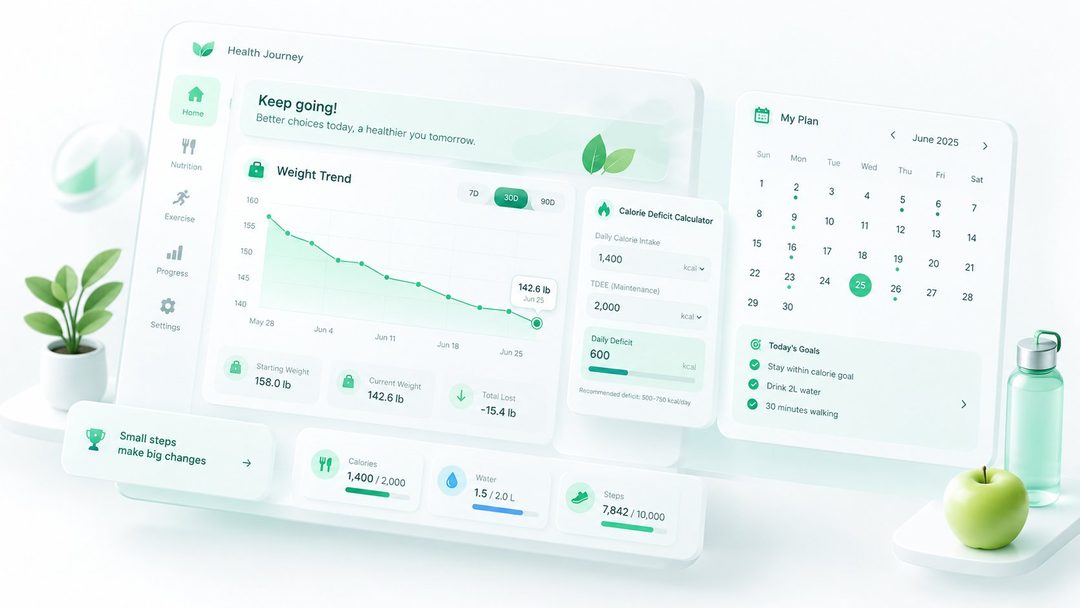
1Build a Clear Sense of Purpose: Calculate Your Caloric Deficit
Fat loss runs on one non-negotiable condition: you have to take in less energy than you burn. What most people get wrong is not the direction of the deficit but its size. Too small and nothing happens; too large and you lose muscle, feel wrecked, and quit within a fortnight.
The Weight Goal Planner turns that guesswork into arithmetic. You enter four values — current weight, target weight, the timeline you want, and your maintenance calories (estimated from your height, age, sex and activity level if you have not calculated them yet). Here is the same example we will follow through all three steps:
| Input | Value |
|---|---|
| Current weight | 78 kg |
| Target weight | 70 kg |
| Target timeline | 15 weeks |
| Maintenance calories | 2,265 kcal |
The planner then returns five numbers that act as a compass for everything else:
| Output | Value | How it is derived |
|---|---|---|
| Weight to lose | 8 kg | 78 − 70 |
| Total calorie deficit | 61,600 kcal | 8 kg × ~7,700 kcal per kg of fat |
| Weekly deficit | 4,107 kcal | 61,600 ÷ 15 weeks |
| Daily deficit | 587 kcal | 4,107 ÷ 7 days |
| Suggested daily intake | 1,678 kcal | 2,265 − 587 |
Why 587 kcal is the right size — and not 1,200. That deficit is about 26% of maintenance, inside the 20–30% band that is widely used for steady fat loss. A deficit above roughly 30% is hard to hold, tends to cost lean mass, and usually rebounds. The planner also tells you when a timeline is unreasonable: aim for 10 pounds in a week and it will say so instead of quietly handing you a 300 kcal target.
This is where the “data compass” earns its keep. Once you know the daily deficit, you stop negotiating with yourself every evening about whether today “counted”. You also stop copying a stranger’s 1,500 kcal menu, which may be a 400 kcal surplus for one person and a starvation diet for another. If you want the background on how maintenance calories are built up from BMR, activity and the thermic effect of food, read how to calculate your TDEE first.
2Ditch the One-Size-Fits-All Diet: Customize Your Three-Phase Plan
Here is the part almost every diet skips. If you eat exactly 1,678 kcal every single day for fifteen weeks, two things happen. Your body adapts — lighter bodies burn less, so a fixed intake becomes a shrinking deficit — and your patience erodes, because flat restriction has no light at the end of it.
Instead, the planner splits the journey into three gradual phases, so intake steps down as your body changes rather than starting at its lowest point on day one:
| Phase | Weeks | Daily target | What it is for |
|---|---|---|---|
| 1 · Adaptation | 1–5 | 1,913 kcal | A mild deficit while you rebuild habits — no hunger, no drama. |
| 2 · Main loss | 6–10 | 1,653 kcal | The steepest stretch, with protein held high to protect muscle. |
| 3 · Convergence | 11–15 | 1,500 kcal | Approach your new maintenance intake instead of crash-landing into it. |
The three targets average out to roughly 1,688 kcal — within a rounding error of the 1,678 kcal from Step 1. That is the point: the phased plan delivers the same total deficit, but spreads the difficulty so that week one is easy enough to survive and week fifteen is close enough to maintenance that the “rebound” never gets a foothold.
Why the last phase matters more than the first
Most regains happen in the fortnight after a diet ends, when intake jumps from a hard deficit straight back to maintenance. Phase 3 exists to avoid that cliff. It also never drops you below a safe floor (1,200 kcal for women, 1,500 kcal for men), so a short timeline cannot push you into a plan your body will not tolerate.
Make it yours before you generate anything
No two households eat the same way, so the generator takes instructions up front: how many meals you want per day (two, three, or three plus snacks), which allergens to exclude (dairy, egg, gluten, nuts, peanut, soy, fish, shellfish, sesame), and any foods you simply refuse to eat. Everything you tick is filtered out of the recipe pool before a single dish is chosen — so the plan is built from food you will actually cook.
3Simplify Your Daily Meals: End the “What Should I Eat Today?” Struggle
Macro targets are meaningless until someone translates them into a plate. What does 1,913 kcal look like when it also has to carry about 130 g of protein, 30 g of fibre, and enough fat for your hormones to behave?
That translation is what the meal plan generator does. For the phase you are currently in, it calculates your protein, fat, carbohydrate and fibre targets, then selects dishes from a library of 100 recipes — each with its own calorie and macro profile — and scales the portion so the day lands within about ±5% of every target. One dish per meal, sized to your allowance: if your lunch needs 700 kcal and the recipe’s base serving is 420 kcal, you get a larger portion rather than two unrelated dishes.
What you end up with is a day that looks like real food, not a spreadsheet:
- Breakfast, lunch, dinner and snacks chosen to hit the phase target, with the portion in grams for each.
- Macro and fibre checks shown per meal and for the day, so you can see where the protein is coming from.
- Allergen-safe by construction — excluded ingredients never enter the pool in the first place.
- A shuffle button when you want variety without redoing the maths, and a retry that keeps the numbers on target.
Nothing is locked behind an account, and nothing is sent to a server: the whole calculation runs in your browser against a recipe file that ships with the site. If you are curious about the numbers behind a single ingredient, the food calorie lookup searches USDA data for it.
See What a Day of Eating Looks Like
Weeks 2 to 15: Keeping the Plan Alive
A plan is a starting estimate, not a guarantee — your real maintenance calories are whatever your weight trend says they are. Three habits keep the numbers honest:
- Weigh in under the same conditions three or four times a week and compare weekly averages, never single days.
- Re-check every two weeks. If the average has not moved for two to three weeks, either drop intake by 100–150 kcal or add 1,500–2,000 daily steps. Change one variable at a time.
- Plan the exit. When you reach the target, add about 100 kcal per week until the scale is stable for two to four weeks. That is maintenance — and it is the number that decides whether the loss sticks.
Weigh-ins are only as consistent as the tool you stand on. If your current bathroom scale drifts between readings or rounds to the nearest half kilo, a flat, reliable digital bathroom scale costs little and is what makes those weekly averages worth comparing at all — same model, same floor, every time.
Disclosure: As an Amazon Associate, BMIbite earns from qualifying purchases. See our Affiliate Disclosure.
Protein and resistance training are what protect the muscle you already have while the scale falls; if that part is new to you, start with 10 high-protein foods that keep you full, then set your split with the macro guide.
The Takeaway
Fat loss is not a punishment you endure; it is a calculation you execute. The chain is short and unglamorous: goal → daily deficit → phased intake → today’s meals. Get those four links right and the “discipline” everyone talks about becomes mostly unnecessary — because you are no longer deciding anything at 7 p.m. with the fridge open.
Skip the 7-day crash diets. Your baseline, your allergens and your target are not the same as anyone else’s, and a plan built on someone else’s numbers is a plan you will abandon.
References & Sources
The key claims in this article are based on the following authoritative sources:
- WHO – Obesity and Overweight Fact Sheet
- NIDDK (NIH) – Weight Management
- NIDDK (NIH) – Body Weight Planner
- Dietary Guidelines for Americans, 2020–2025
- HHS – Physical Activity Guidelines for Americans, 2nd Edition
- Mifflin-St Jeor et al. (1990), A New Predictive Equation for Resting Energy Expenditure — Am J Clin Nutr (PubMed)
Ready to put this into practice?
Calculate your daily calorie needs, then turn your goal into a week-by-week weight plan — both free, no sign-up required.
Disclaimer: This article is for informational purposes only and does not constitute medical advice. Always consult with a healthcare provider before starting any new diet or exercise regimen.