From BMI to TDEE: How to Calculate Your Daily Calorie Needs
Just calculated your BMI? Here's what to do next — learn how to calculate your TDEE and find out exactly how many calories you need to eat daily to reach your goals.

BMI tells you where you are. TDEE tells you what to do.
So, you've just used a BMI calculator. You know if you're underweight, normal weight, overweight, or obese. But now what?
Your BMI is a great starting point, but it tells you where you are, not how to get to where you want to be. To actually lose, gain, or maintain weight, you need to understand your daily calorie needs. This is where TDEE (Total Daily Energy Expenditure) comes in.
Don't know your BMI yet? Start by calculating your BMI here first.
A Quick Refresher: What is BMI?
BMI, or Body Mass Index, is a simple screening tool that uses your height and weight to estimate your body fat.
- Below 18.5: Underweight
- 18.5 – 24.9: Normal weight
- 25.0 – 29.9: Overweight
- 30.0 and above: Obese
While BMI is useful for a quick check, it doesn't tell you how much energy your body actually burns. That's where TDEE comes in.
What is TDEE and Why Does It Matter?
TDEE stands for Total Daily Energy Expenditure. In simple terms, it's the total number of calories you burn in a day. Your TDEE is made up of four components:
- BMR (Basal Metabolic Rate): The calories you burn just by existing — breathing, pumping blood, and so on.
- TEF (Thermic Effect of Food): The calories burned digesting the food you eat.
- EAT (Exercise Activity Thermogenesis): The calories burned during intentional exercise.
- NEAT (Non-Exercise Activity Thermogenesis): The calories burned during daily activities like walking, typing, or doing chores.
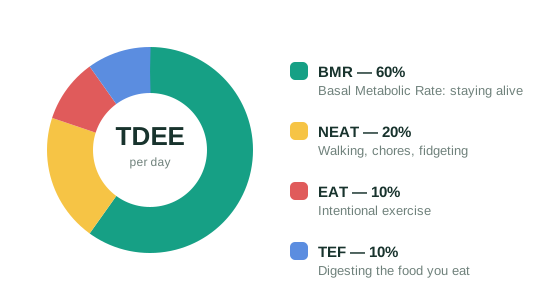
When you consume exactly your TDEE, you maintain your current weight. Consume less, and you lose weight. Consume more, and you gain weight.
How to Calculate Your TDEE (Step-by-Step)
While there are complex formulas to calculate TDEE, you only need two steps to get a highly accurate estimate.
Step 1: Calculate Your BMR (Basal Metabolic Rate)
The most accurate widely-used formula is the Mifflin-St Jeor Equation:
For Women: (10 × weight in kg) + (6.25 × height in cm) − (5 × age in years) − 161
Step 2: Multiply by Your Activity Level (The TDEE Factor)
| Activity level | Factor |
|---|---|
| Sedentary (little or no exercise) | BMR × 1.2 |
| Lightly active (light exercise 1–3 days/week) | BMR × 1.375 |
| Moderately active (moderate exercise 3–5 days/week) | BMR × 1.55 |
| Very active (hard exercise 6–7 days/week) | BMR × 1.725 |
| Extra active (very hard exercise, physical job) | BMR × 1.9 |
Don't want to do the math by hand? Our free Calorie Calculator does both steps instantly.
Translating Your TDEE into Real Food
Here is the biggest mistake people make: they calculate their TDEE, memorize the number, but have absolutely no idea what that looks like on a plate.
Is 2,000 calories a day two large pizzas? Or is it four chicken breasts, a mountain of vegetables, and a bowl of rice?

The answer is: it depends entirely on what you eat.
To make your TDEE number actionable, you need to track your food. This is exactly why we built our Food Calorie Database. You can search thousands of foods (based on the latest USDA Foundation Foods data) to see exactly how many calories, grams of protein, carbs, and fat they contain. Instead of guessing, you can build your daily meals with precision.
Try our Free Food Calorie Tool here to see what's in your next meal.
What Now? Losing, Gaining, or Maintaining
Now that you know your TDEE and how to track your calories, what should you do?
- To Maintain Weight: Eat exactly your TDEE.
- To Lose Weight (Calorie Deficit): Eat 300–500 calories less than your TDEE. A 500-calorie daily deficit generally leads to about 1 lb (0.45 kg) of weight loss per week.
- To Gain Weight/Muscle (Calorie Surplus): Eat 300–500 calories more than your TDEE, paired with strength training.
Planning a deficit? The Weight Loss Planner turns your TDEE into a week-by-week timeline.
Frequently Asked Questions
Can I calculate my TDEE from my BMI?
Not directly. BMI uses height and weight, while TDEE requires your age, gender, and activity level. However, BMI gives you a starting point to understand if your weight is in a healthy range before you calculate your calorie needs.
How accurate is a TDEE calculation?
It's an estimate. Everybody's metabolism is slightly different. Use your calculated TDEE as a starting point, monitor your weight for 2–3 weeks, and adjust your calories up or down based on actual results.
Are all calories the same?
For pure weight loss or gain, a calorie is a calorie. However, for overall health, 100 calories of broccoli is vastly superior to 100 calories of candy because of the fiber, vitamins, and satiety it provides.
The Takeaway
Your health journey doesn't end with a BMI score; it begins there. By calculating your TDEE and tracking your daily food intake, you take complete control of your nutrition.
Disclaimer: This article is for informational purposes only and does not constitute medical advice. Always consult with a healthcare provider before starting any new diet or exercise regimen.