The Ultimate Weight Loss Planner: From BMI Chart to Calorie Deficit
Confused by BMI charts and calorie numbers? Learn the WHO BMI cut-off points, how to turn your BMI into a daily calorie target, and how to plan your weight loss safely.
A Plan Beats Willpower
If you are trying to lose weight, you probably have a lot of questions. What is a healthy BMI? What does "morbidly obese" actually mean? And most importantly — how many calories should I eat to actually lose weight?
A successful weight loss journey isn't just about eating less; it's about having a clear plan. In this guide, we'll break down the official WHO BMI standards, explain how to bridge the gap between your BMI and your daily calorie needs, and help you build a sustainable weight loss plan.
What Is a Healthy BMI? The WHO Cut-Off Points Explained
BMI (Body Mass Index) is the standard screening tool used worldwide to assess weight status. According to the World Health Organization, a BMI between 18.5 and 24.9 is the gold-standard range for "normal weight" in adults.
Here is the official WHO BMI classification for adults:
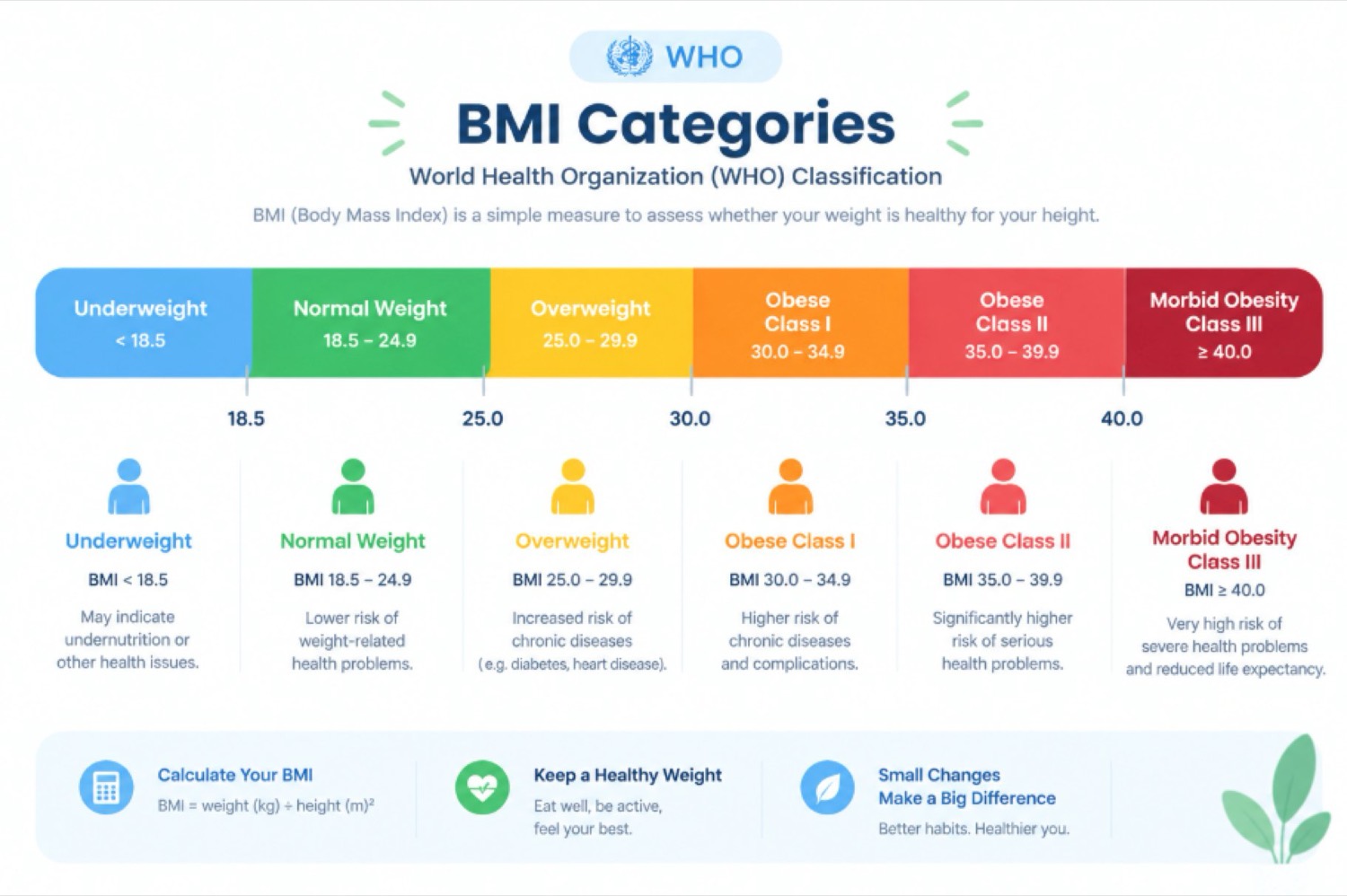
- Underweight: BMI less than 18.5
- Normal weight: BMI 18.5 to 24.9
- Overweight: BMI 25.0 to 29.9
- Obesity Class I: BMI 30.0 to 34.9
- Obesity Class II: BMI 35.0 to 39.9
- Morbid obesity (Class III): BMI 40.0 or higher
Understanding the "Morbidly Obese" Weight Range
When someone reaches the morbidly obese range (BMI ≥ 40), their weight poses a severe risk to their health, including a much higher likelihood of heart disease, type 2 diabetes, and sleep apnea. If you fall into this category, it is strongly recommended to consult a healthcare professional before starting any aggressive calorie deficit — a gradual, supervised plan is both safer and more likely to last.
Body Mass Index Chart in KG (Quick Reference)
To estimate where you stand without a calculator, here is a simplified BMI chart in kilograms based on height. It shows the weight ranges for the three main bands: normal, overweight, and obese (BMI 30 or above).
| Height | Normal (18.5–24.9) | Overweight (25.0–29.9) | Obese (≥ 30.0) |
|---|---|---|---|
| 150 cm | 41.6–56.0 kg | 56.3–67.3 kg | ≥ 67.5 kg |
| 155 cm | 44.4–59.8 kg | 60.1–71.8 kg | ≥ 72.1 kg |
| 160 cm | 47.4–63.7 kg | 64.0–76.5 kg | ≥ 76.8 kg |
| 165 cm | 50.4–67.8 kg | 68.1–81.4 kg | ≥ 81.7 kg |
| 170 cm | 53.5–72.0 kg | 72.3–86.4 kg | ≥ 86.7 kg |
| 175 cm | 56.7–76.3 kg | 76.6–91.6 kg | ≥ 91.9 kg |
| 180 cm | 59.9–80.7 kg | 81.0–96.9 kg | ≥ 97.2 kg |
| 185 cm | 63.3–85.2 kg | 85.6–102.3 kg | ≥ 102.7 kg |
| 190 cm | 66.8–89.9 kg | 90.3–107.9 kg | ≥ 108.3 kg |
For example, at 170 cm the normal-weight band runs from 53.5 kg to 72.0 kg; anything at or above 86.7 kg falls into the obese range.
From BMI to Calories: How the Numbers Connect
Here is where most people get stuck. Knowing your BMI tells you where you are, but it doesn't tell you how to get where you want to be. For that you need your TDEE — Total Daily Energy Expenditure, the number of calories you burn in a day.
A good weight loss calculator does two things:
- It assesses your starting point (your BMI and healthy weight range).
- It estimates how many calories you burn daily, based on your age, sex, height, weight, and activity level.
Setting Up Your Macros: Which Split Fits You?
Once you know your calorie target, the next step is splitting those calories into protein, carbs, and fat. You may have seen the "20/40/40" split floating around fitness forums — it can work, but for most people one of these three evidence-friendly splits is easier to stick to:
- Balanced (30% protein / 40% carbs / 30% fat): best for most beginners. The easiest to maintain long term.
- High protein (40% protein / 30% carbs / 30% fat): best for preserving muscle while losing fat, especially if you lift weights.
- Lower carb (30% protein / 20% carbs / 50% fat): a good option if you feel constantly hungry on higher-carb diets.
Whichever split you choose, hit your protein target first — it is the one that protects your muscle and keeps you full.
Your Step-by-Step Weight Loss Planner
Now let's put it all together:
- Calculate your BMI. Understand whether you are in the normal, overweight, or obese range.
- Calculate your TDEE with a calorie calculator.
- Set your daily calorie goal: TDEE minus 300–500 calories.
- Set your macros (for example, 30% protein / 40% carbs / 30% fat).
- Track your food. This is the step that decides whether the plan actually happens.
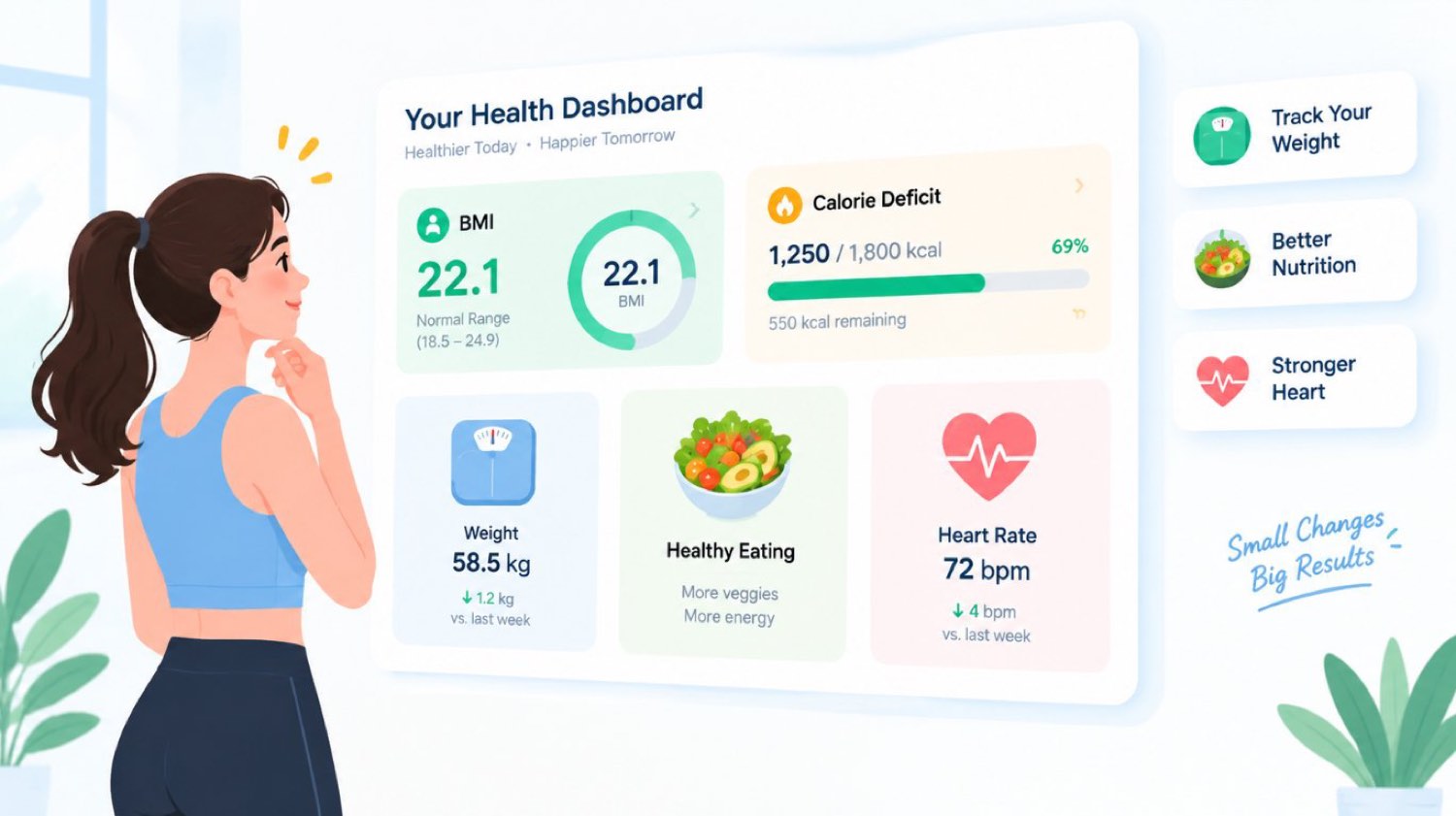
The Easiest Way to Track
You don't need to guess. Use our Food Search Tool to look up thousands of basic foods (powered by USDA data), or use our new Camera Barcode Scanner to instantly check packaged foods at the grocery store — point your camera at the barcode and the calories, protein, carbs, fat and sugar show up in seconds.
Frequently Asked Questions
What is the difference between overweight and obese?
According to the WHO, overweight is a BMI of 25.0 to 29.9. Obesity starts at a BMI of 30.0, and is further divided into Class I (30.0–34.9), Class II (35.0–39.9) and Class III, sometimes called morbid obesity (40.0 and above).
Can I use a weight loss calculator if I am morbidly obese?
Yes, but be aware that standard formulas may overestimate your daily calorie burn, and very large deficits carry extra risk. It is strongly advised to involve a doctor or registered dietitian to set a safe, gradual plan.
How often should I recalculate my BMI and calorie goals?
Recheck your BMI and adjust your calorie target every time you lose about 5–10 lb (2–4 kg). Your TDEE drops as your weight drops, so the deficit that worked at the start will eventually stop working.
The Bottom Line
You don't have to guess your way to better health. By understanding the WHO BMI cut-off points, using a reliable calorie calculator, and planning your macros, you have a clear roadmap — and every step above takes less than a minute with the right tool.
Ready to build your plan? Start with the numbers, then let tracking do the rest.