BMI Normal but Still “Skinny Fat”? What the Calculator Isn’t Telling You
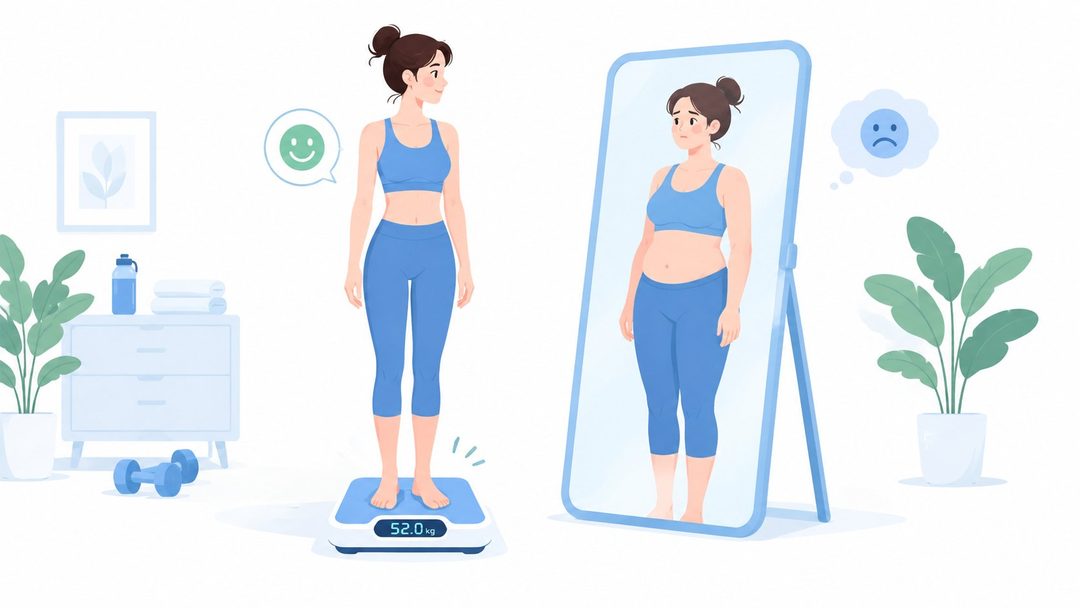
You step on the scale and the number looks fine. You plug your height and weight into a calculator and your BMI lands neatly inside 18.5–24.9. Then you look in the mirror: soft arms, a stomach that never quite flattens, a body that feels nothing like the number claims. You are not imagining it. BMI is doing exactly what it was designed to do — and it was never designed to see inside you.
Check Your BMI & Daily Calories
1. Why BMI “Lies” to Your Mirror
The formula could not be simpler: weight in kilograms ÷ height in metres squared. It was built in the 19th century as a way to describe populations, not individuals, and it still does that job well — it is cheap, it needs nothing but a scale and a tape measure, and across hundreds of thousands of people it tracks obesity trends reliably.
What it cannot do is split the number on top of the fraction into its parts. A kilogram of muscle and a kilogram of fat weigh the same; that is the whole problem.
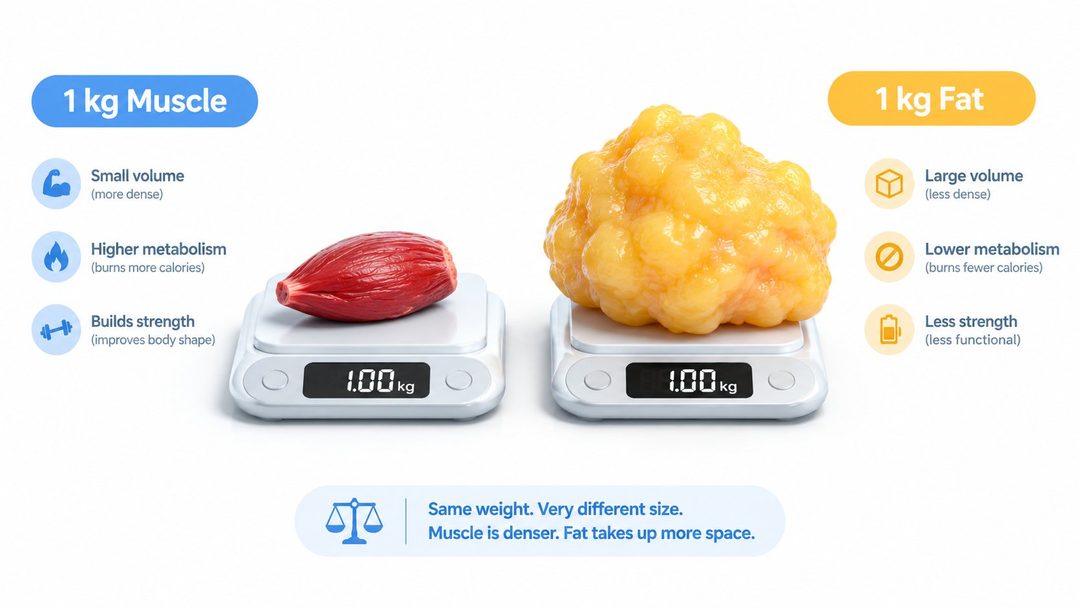
Two people can therefore share a BMI of 22 and be in completely different physical states:
- A trained lifter with dense muscle and very low body fat — healthy by any measure, despite occasionally being flagged as “overweight” at a BMI of 27.
- An office worker who has never lifted, has little muscle mass and carries fat around the organs — a “normal” BMI that hides a genuinely unfavourable body composition.
Swap three kilograms of muscle for three kilograms of fat and your BMI does not budge by a decimal point, while your body looks and feels noticeably softer. This is the gap the health literature calls normal weight obesity (NWO), or more colloquially, “skinny fat”.
2. Why It Matters Beyond Vanity
The part that deserves attention is not the lack of tone. It is where the fat sits. Fat stored under the skin (subcutaneous) is mostly a cosmetic issue; fat packed around the liver, pancreas and intestines (visceral) behaves like an active organ. It releases free fatty acids straight into the portal vein, produces inflammatory signalling molecules such as IL-6 and TNF-α, and lowers protective adipokines like adiponectin. The downstream effects are insulin resistance, unfavourable blood lipids and fat accumulating in the liver — all of which can develop at a perfectly respectable BMI.
This is not a theoretical worry. A systematic review and meta-analysis of 24 cross-sectional studies covering 75,201 adults compared people with normal weight obesity against lean, metabolically normal controls. Normal weight obesity was associated with roughly 2.2× the odds of metabolic syndrome, about 1.7× the odds of diabetes and 1.6× the odds of hypertension. The authors concluded that defining obesity by BMI alone should be questioned.
One important nuance: not everyone with a normal BMI and higher body fat is metabolically unhealthy. The point is that BMI cannot tell you which group you are in. If your waist is above half your height — our guide to why waist circumference matters more than weight covers the exact measuring protocol — that is a reason to get fasting glucose, HbA1c, a lipid panel and liver enzymes checked rather than to guess.
3. Three Numbers That Tell You More Than BMI
None of these requires a lab. All three are more informative than a single weight reading, and each one takes under two minutes.
| Metric | How to get it | Threshold to note |
|---|---|---|
| Waist-to-height ratio (WHtR) | Waist circumference ÷ height, both in the same unit. | Keep it under 0.5. A 170 cm person should stay under an 85 cm waist. |
| Body fat percentage | Smart scale, calipers or, most accurately, a DEXA scan. | A common research cut-off for “high” at a normal BMI is about 20% for men and 30% for women; athletic ranges sit well below that. |
| Waist-to-hip ratio (WHR) | Waist ÷ hip circumference at the widest point. | Above 0.90 for men or 0.85 for women signals central obesity. |
The waist-to-height ratio earns its place at the top of that list. A meta-analysis pooling data from more than 300,000 adults found it detected cardiometabolic risk better than BMI and slightly better than waist circumference alone, with a single threshold that works across sexes and ethnic groups: keep your waist to less than half your height. One division, no chart, no age adjustment.
Measure your waist properly, or the number is noise. Stand relaxed, find the midpoint between your lowest rib and the top of your hip bone, and wrap the tape there — not at your navel and not at your trouser line. Breathe out normally, let the tape sit snug against the skin without compressing it, and do not suck in. Measure twice and take the average. Body fat scales, by contrast, can be off by several percentage points depending on hydration, so read the trend over months, never a single morning.
Get Your BMI and Maintenance Calories
4. How to Fix “Skinny Fat” in Three Steps
Here is the counter-intuitive part: the answer is usually not a stricter diet. If you already carry little muscle, a severe calorie deficit mostly removes the tissue you can least afford to lose, and you end up lighter, softer and hungrier than when you started.

1Lift weights two to three times a week
Running burns calories but builds almost no muscle, which is why a cardio-only routine can leave you lighter and still soft. Resistance training is the only practical way to tell your body to keep — or add — lean mass while fat comes down. The US Physical Activity Guidelines recommend muscle-strengthening work on two or more days a week; two full-body sessions is a realistic starting point.
Cover the basic patterns rather than chasing exotic exercises: a squat, a hip hinge (deadlift or Romanian deadlift), a push (press-up or overhead press), a pull (row or lat pulldown) and a carry. You do not need a gym membership for any of them — a single pair of adjustable dumbbells turns a corner of your living room into enough equipment for months of progress, and squats, rows, presses and carries all fit inside about one square metre. Add a little weight or a repetition every week or two. Progress, not soreness, is the signal that it is working.
Disclosure: As an Amazon Associate, BMIbite earns from qualifying purchases. See our Affiliate Disclosure.
2Eat protein at every meal
Protein supplies the raw material for muscle and is the most satiating macronutrient, which makes the deficit easier to hold. A commonly used target during fat loss with resistance training is roughly 1.2–1.6 g per kilogram of body weight per day, spread across meals rather than piled into dinner. For a 65 kg person that is about 80–105 g a day — a palm-sized portion of chicken, fish, eggs, Greek yogurt, tofu or legumes at each sitting.
If you want to see where your protein is actually coming from, the food calorie lookup searches USDA data for single ingredients, and the barcode scanner reads the label on anything packaged. Our guide to high-protein foods lists the best options per 100 g.
3Judge progress by your waist, not the scale
When you gain muscle and lose fat at the same time, body weight can sit still for weeks while your shape changes. That is success, not a plateau. Track three things weekly: waist circumference at the same spot, a front-on photo in the same light, and how a pair of trousers fits. If the waist is shrinking, you are getting healthier regardless of what the scale says.
On the food side, aim for maintenance calories or a small deficit of roughly 300–500 kcal — not more. If you have not calculated maintenance yet, start with how to calculate your TDEE and then set the size of the deficit with the calorie deficit guide.
5. Four Things That Make It Worse
- Crash dieting. A very low intake without resistance training accelerates lean mass loss — the exact opposite of the goal.
- Cardio as the only training. Useful for heart health and energy balance; not a muscle-building stimulus.
- Weighing yourself daily and reacting to it. Day-to-day fluctuations are water and glycogen. Weekly averages are the only readable signal.
- Assuming a normal BMI means no risk. If your waist is over half your height, ask for bloodwork rather than reassurance from a calculator.
The Bottom Line
BMI is a blunt screening instrument, and it is not lying to you — it is simply not answering the question you are asking. A normal BMI tells you that your total mass is unremarkable for your height. It says nothing about whether that mass is muscle or fat, or where the fat is stored.
So stop trying to make the number smaller as your first move. Measure your waist, divide it by your height, and if the answer is above 0.5, make the plan about composition: lift two or three times a week, eat enough protein, hold a small deficit if needed, and let the tape measure — not the scale — tell you whether it is working. Healthier is a body with more muscle and less visceral fat, not simply a lighter one.
Frequently Asked Questions
Can you be skinny fat with a normal BMI?
Yes. BMI only compares total weight with height, so it cannot see how much of that weight is fat. A person with a BMI of 21 and very little muscle can carry a high body fat percentage — the pattern researchers call normal weight obesity.
What body fat percentage counts as skinny fat?
Definitions vary between studies. A frequently used research cut-off is body fat above roughly 20% for men and 30% for women while BMI stays in the 18.5–24.9 range. Consumer smart scales can be several points off, so treat the number as a trend rather than a verdict.
Is skinny fat reversible without losing weight?
Often, yes. Resistance training two to three times a week plus adequate protein lets you add muscle and lose fat at a similar body weight. Most people see waist measurements move within eight to twelve weeks, well before the scale changes much.
Should I lose weight or build muscle first?
If your waist-to-height ratio is above 0.5 or your body fat is clearly high, start with a small deficit of roughly 300–500 kcal while lifting. If your waist is already under half your height and you simply feel soft, eat near maintenance and prioritise muscle instead.
References & Sources
The key claims in this article are based on the following authoritative sources:
- WHO – Obesity and Overweight Fact Sheet
- Rakhmat et al. (2022), Cardiometabolic Risk Factors in Adults with Normal Weight Obesity: A Systematic Review and Meta-analysis — Clin Obes (PubMed)
- Ashwell, Gunn & Gibson (2012), Waist-to-height Ratio Is a Better Screening Tool than Waist Circumference and BMI for Adult Cardiometabolic Risk Factors — Obes Rev
- Lean, but Not Healthy: The “Metabolically Obese, Normal-weight” Phenotype — Curr Opin Clin Nutr Metab Care (PubMed)
- HHS – Physical Activity Guidelines for Americans, 2nd Edition
- NIDDK (NIH) – Body Weight Planner
Ready to put this into practice?
Calculate your daily calorie needs, then turn your goal into a week-by-week weight plan — both free, no sign-up required.
Disclaimer: This article is for informational purposes only and does not constitute medical advice. Body composition, waist thresholds and calorie targets are general guidance, not a diagnosis. Consult a healthcare provider before starting a new diet or exercise programme, especially if you have a chronic condition.